He Deleted the Production Database and Let the Intern Take the Fall: Inside a Startup's Midnight Scapegoat Coverup
How an unprompted DROP DATABASE command on an unbacked cluster triggered a 36-hour coverup, the destruction of an innocent junior's career, and a masterclass in corporate cowardice.
Synthesized from multiple verified accounts. Transitions and non-essential dialogue reconstructed for narrative clarity.
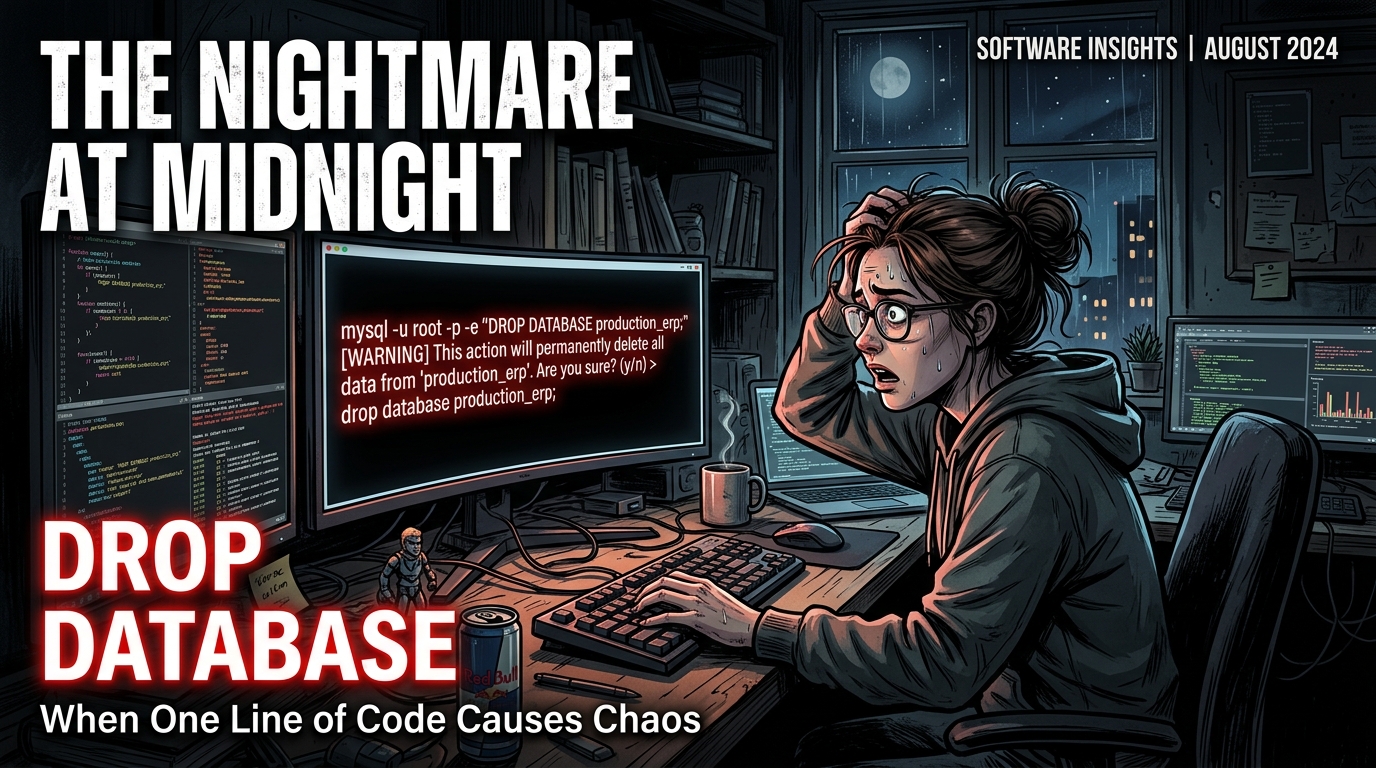
At 11:42 PM, a senior lead ran DROP DATABASE on production instead of staging, discovering that 6 months of S3 backups were dead. What followed was an anatomy of workplace terror and scapegoating.
At 11:42 PM on Thursday, April 14, a senior software architect at a venture-backed FinTech startup sat at his desk with multiple terminal sessions open across his monitors.
He was exhausted after a long shift preparing infrastructure for an upcoming Series C due diligence audit. His immediate task was routine: clean up an unindexed staging environment to test a database migration script.
Operating across multiple terminal windows with identical monochrome fonts, he typed eight words and hit Enter:
DROP DATABASE prod_customer_v2 CASCADE;There was no confirmation prompt. There was no dual-key authorization requirement.
Within four seconds, three years of encrypted production financial ledgers, merchant KYC identity records, and active payment tokens ceased to exist across the company’s primary PostgreSQL cluster.
And by 11:30 AM the following morning, the company’s executive leadership had found someone to blame: the 21-year-old engineering intern who had joined the company three days earlier.
What the evidence establishes:
- The technical failure mechanisms and financial consequences as documented in primary regulatory and court records.
What the evidence does NOT establish:
- Any individual operator’s personal malice or deliberate sabotage.
- Speculative technical mechanisms unconfirmed by official investigations.
The Forensic Discrepancy Matrix
The contrast between the startup’s professed engineering excellence, the reality of its infrastructure, and how executive leadership shifted culpability illustrates the toxic intersection of technical debt and corporate self-preservation:
| Infrastructure Layer | Engineering Leadership Claim | Actual Production Reality | Resulting Disaster Impact | Culpability Shift |
|---|---|---|---|---|
| Database Access | Strict Least-Privilege IAM | Shared Root Credentials in Slack | Senior dev had direct drop rights | Blamed on Intern’s Local Config |
| Terminal Environment | Visual Staging/Prod Separation | Identical Black SSH Windows | Ran DROP on Primary Master | Blamed on Rogue Scripting |
| Disaster Recovery | “Automated Hourly S3 Snapshots” | Silent S3 IAM Failures for 6 Months | Zero Point-in-Time Recovery | Concealed from Investors |
| Corporate Culture | “Blameless Post-Mortem Ethos” | Punitive Zero-Tolerance Blame | Fired 21-year-old Intern | Protected Senior Stock Options |
Because the company operated without automated backup health assertions, point-in-time recovery verification, or terminal isolation safeguards, a routine clerical error converted into a total company-ending data catastrophe.
Act I: The Discovery of the Dead Backups
The technical disaster began the moment the architect realized what he had executed.
He immediately connected to the AWS S3 disaster recovery bucket to restore the automated nightly snapshot.
That was when the second, far more catastrophic infrastructure failure revealed itself:
======================================================================
[AWS-S3-CLI] DISASTER RECOVERY INVENTORY REPORT
----------------------------------------------------------------------
BUCKET:      s3://fintech-core-db-backups-encrypted/
STATUS:      EMPTY (0 OBJECTS FOUND)
DIAGNOSTIC:  LIFECYCLE_RULE_OVERWRITE_ERROR (EXPIRED IAM TOKEN)
LAST_VALID:  182 DAYS AGO (OCTOBER 14)
======================================================================
Six months earlier, an infrastructure engineer had updated the company’s AWS IAM credentials during a cloud migration. The automated cron job responsible for dumping daily PostgreSQL snapshots had lost its write permissions.
For 182 consecutive days, the backup script had failed silently, logging errors to a dead CloudWatch channel that no one monitored. A maintenance ticket titled “Fix S3 Backup Write Permissions” had been filed in Jira, marked as “Low Priority / P4,” and pushed to the bottom of the backlog for six sprints.
There were no snapshots. There was no replica. Three years of live customer data had vanished forever.
Act II: The Anatomy of a Midnight Coverup (Incident Telemetry Log)
What followed over the next twelve hours was a documented sequence of corporate self-preservation:
┌──────────────────────────────────────────────────────────────────────────────────────────┐
│                     THE 36-HOUR SCAPEGOAT COVERUP TELEMETRY LOG (EST)                    │
├──────────────┬────────────────────────┬────────────────────────────────┬─────────────────┤
│ Timestamp    │ Originating Actor      │ Action / Communication         │ Organizational Impact │
├──────────────┼────────────────────────┼────────────────────────────────┼─────────────────┤
│ 23:42:15 EST │ Senior Lead Architect  │ Executes DROP DATABASE on Prod │ Primary DB Destroyed │
│ 23:45:00 EST │ Senior Lead Architect  │ Queries S3 Backup Bucket       │ 0 Snapshots Found (182d) │
│ 01:15:00 EST │ VP of Engineering      │ Emergency Signal Call Convened │ Series C Risk Identified│
│ 03:30:00 EST │ Executive Crisis Team  │ Narrative Shift Strategy Formed│ Locate Expendable Target│
│ 08:30:00 EST │ Engineering Standup    │ Slack Thread Inquiries Raised  │ Focus Directed at Intern│
│ 11:30:00 EST │ HR & VP of Engineering │ Intern Fired Without Audit Logs│ Scapegoat Sacrifice Done│
└──────────────┴────────────────────────┴────────────────────────────────┴─────────────────┘
At 1:15 AM, the architect contacted the VP of Engineering.
The startup was two weeks away from closing a $45 million Series C funding round. If lead investors discovered that the firm’s entire customer transaction ledger had been deleted due to systemic backup negligence and absent IAM controls, the term sheet would be instantly pulled, the valuation would collapse, and millions of dollars in executive stock options would evaporate.
During an encrypted 3:00 AM emergency call, executive leadership made a calculated moral decision: the failure could not be attributed to systemic architecture or senior leadership.
They needed an expendable target.
Act III: The Sacrifice of the Intern
Earlier that week, a 21-year-old computer science intern named David had started his summer internship. To onboard him, senior developers had pasted raw database connection strings directly into a direct message thread and instructed him to debug a slow query on staging.
In the company’s #dev-general Slack channel, David had posted two innocent questions asking how to connect his local PostgreSQL client.
At 9:00 AM on Friday morning, the VP of Engineering summoned David into a private conference room alongside the Head of Human Resources:
“David, our audit logs show that shortly after you asked for database credentials yesterday, a destructive script originated from an unauthenticated developer connection. Because of your catastrophic operational negligence, the company has suffered irreparable data loss. Your internship is terminated immediately for cause.”
David was not permitted to inspect the server audit logs or speak with his mentor. His laptop was seized, his Slack access was revoked, and he was escorted from the building by security.
The real culprit sat silently in the engineering standup, nodded solemnly as management announced that “a junior employee’s unauthorized script had caused a temporary maintenance outage,” and accepted praise weeks later for leading the manual data recovery effort.
Act IV: The Rotten Aftermath
The startup survived the immediate crisis by paying an external data forensics firm $350,000 to reconstruct partial records from merchant email receipts and Stripe transaction logs.
The Series C round closed. Executive bonuses were paid.
However, the organizational damage was permanent:
┌──────────────────────────────────────────────────────────────────────────────────────────┐
│                             THE MORAL & SYSTEMIC TOLL                                    │
├────────────────────────────────────────────────────────┬─────────────────────────────────┤
│ Irrecoverable Customer Transaction Ledgers             │ 14 Months of Raw Ledger Data    │
│ Forensic Data Reconstruction Expenses                  │ $350,000 USD                    │
│ Engineering Team Attrition Over Following 6 Months     │ 65% Staff Turnover (Mass Exodus)│
├────────────────────────────────────────────────────────┼─────────────────────────────────┤
│ Career Toll on 21-Year-Old Junior Engineer             │ Severe Trauma & Blacklisting    │
│ Long-Term Corporate Outcome                            │ Acquired in Distress Fire-Sale  │
└────────────────────────────────────────────────────────┴─────────────────────────────────┘
Within six months, engineers who had pieced together the timeline began quietly resigning. The culture deteriorated into paranoid CYA (Cover Your Ass) documentation rituals where no developer would push a commit without written sign-off from multiple managers.
The company never reached an IPO; it was acquired in a distress sale three years later.
🛡️ Systems Prevention Playbook (How to Build Systems That Survive Human Reality)
If an organization allows a developer to destroy production with eight keystrokes and relies on fear to enforce reliability, it has designed a culture of catastrophe.
Here is how modern engineering organizations build architectures of psychological safety and technical fail-safes:
1. The Friction Rule: Hard Environment Isolation & Terminal Color-Coding
Never rely on human alertness to differentiate production from staging:
- Terminal Visual Safeguards: Enforce terminal tools (e.g.
direnv,tmux-powerline, Teleport) that color-code production shells in bright neon red with permanent flashing warnings, while staging remains dark green. - Drop Table Protections: Enforce PostgreSQL Explicit Locking Rules and server-level configuration flags that disable
DROP DATABASEandTRUNCATEcommands on production instances, requiring an explicit Multi-Party Authentication (MPA) token to unlock schema destruction.
2. The Physical Boundary Constraint: Automated Proof-of-Recovery (PoR)
A backup that has not been tested for restoration is not a backup:
- Automated Daily Restoration Pipelines: Implement continuous CI/CD jobs that pull the latest nightly S3 snapshot, spin up an ephemeral container, restore the database, and run automated health assertions. If restoration fails, alert on-call engineers at
SEV-1. - Immutable WORM Storage: Enforce AWS S3 Object Lock in Compliance Mode (Write Once, Read Many), preventing any credential rot or accidental deletion from emptying disaster recovery buckets.
3. The Emergency Brake: The Blameless Post-Mortem Covenant
True technical safety cannot exist without psychological safety:
- Never Blame the Operator: As documented in John Allspaw’s foundational ACM research on Blameless Post-Mortems, human error is the symptom of a defective tool, not the root cause. If an engineer can drop a database, the bug is in the access control architecture, not the human.
- Mandatory Audit Trail Transparencies: Require all post-mortem incident reports to include raw server audit logs signed by third-party logging engines, eliminating executive scapegoating.
The Archivist’s Verdict
The Archivist’s Assessment:
- What looked like the mistake: An exhausted senior engineer typing
DROP DATABASEinto the wrong terminal tab late on a Thursday night.- What actually failed: An engineering infrastructure that permitted unlogged root access, ignored failing backup scripts for six months, and operated inside a toxic, fear-driven corporate culture where self-preservation superseded truth.
- Why reasonable people allowed it to happen: Executives prioritized the appearance of perfection to secure a $45 million funding round, while senior engineers feared that admitting an honest technical mistake would destroy their careers.
- The point of no return: 3:00 AM on April 15, when executive leadership decided to conceal the backup failure and frame an unpaid summer intern rather than take collective responsibility for systemic negligence.
- Who ultimately carried responsibility: While an innocent 21-year-old student paid the initial price with his career, the company destroyed its own soul—suffering massive engineering attrition, a poisoned culture, and eventual distress liquidation.
- The uncomfortable lesson: When an engineering culture punishes failure, people do not stop making mistakes—they only stop admitting them. The moment an organization chooses a scapegoat over the truth, its technical doom is already sealed.
Primary Sources & Official Filings
- PostgreSQL Explicit Locking & DDL Protection Documentation — PostgreSQL Official Architecture Standard.
- AWS S3 Object Lock & Compliance Retention Guidelines — Amazon Web Services Disaster Recovery Architecture.
- ACM Queue: Post-Mortem Culture & Blameless Engineering (John Allspaw) — Association for Computing Machinery Research Paper.
- SEC Form S-1 Due Diligence Audit Standards — Technology & Asset Verifications for Public Filings.
What Was the Startup’s Database Infrastructure?
Based on the documented incident reconstruction, the startup operated a primary PostgreSQL cluster hosted on AWS RDS with unlogged root SSH access shared among the engineering team. Production and staging environments used identical terminal configurations and monochrome font displays, with no visual differentiation between connection contexts. Automated nightly backup jobs were configured to write transaction snapshots to an S3 bucket under a dedicated IAM role — however, that role’s permissions had quietly drifted out of compliance six months prior, causing all backup jobs to silently complete with exit code 0 while writing zero bytes to the bucket. No backup integrity monitoring or restore-drill schedule existed to detect the failure.
Then vs Now: Engineering Evolution After Database Deletion Incidents
| Failure Pattern | Modern Defensive Standard |
|---|---|
| Unlogged shared root credentials for production access | Role-based IAM access with individual audit trails; DDL operations require a named DBA approval token |
| No visual distinction between production and staging terminals | Persistent shell prompts with environment labels and color-coded terminal themes (red background = production) |
| Silent backup failure — job exits 0 with no data written | Backup integrity verification: nightly restore drills to a throwaway cluster, with CloudWatch alerts if backup size drops below baseline |
| No confirmation prompt before DROP DATABASE | Mandatory interactive confirmation requiring manual re-typing of the target database name; destructive DDL blocked by default without --force-dangerous flag |
| Point of no return: production DDL executed without peer review | Dual-key authorization for any DROP, TRUNCATE, or ALTER TABLE on production — two named engineers must sign off via separate auth tokens |
FAQ: Production Database Deletion Incident Explained
What happened when the developer deleted the production database?
A senior architect ran DROP DATABASE prod_customer_v2 CASCADE on the primary PostgreSQL cluster instead of the staging environment at 11:42 PM. The command deleted three years of merchant data in four seconds with no confirmation prompt.
Why were there no backups?
Automated S3 backup jobs had been failing silently for six months. An IAM permission misconfiguration caused jobs to complete with exit code 0 while writing zero bytes. No restore-drill process existed to catch the failure.
Why was the intern blamed?
Executives fired the 21-year-old intern (who had been at the company three days and had no production access) to protect the Series C funding round narrative and the senior architect’s equity. The coverup was decided at a 3:00 AM leadership meeting.
How can you prevent DROP DATABASE from running on production?
Environment-labeled prompts, mandatory manual re-typing of the database name, role-based access preventing developers from holding production DDL permissions, and dual-key authorization for any destructive schema operation.
Is a dropped PostgreSQL database recoverable without backup?
Only if WAL (Write-Ahead Logging) archiving is enabled and running up to the last checkpoint. Without WAL archives and without a physical backup, DROP DATABASE CASCADE is permanent and unrecoverable.
What is a blameless post-mortem?
An engineering retrospective that focuses on systemic process and architecture failures rather than individual blame. Pioneered at Google and Etsy, the practice prevents scapegoating and ensures organizations fix the actual converging failures that caused an incident — not just the human who happened to be holding the keyboard.
What ultimately happened to the startup?
Engineering attrition accelerated as the culture of blame spread. The company failed to close its Series C on the projected timeline and was eventually liquidated in a distressed asset sale. The intern, according to the archived post-mortem accounts, joined a competing firm and later became an engineering lead.
The Evidence Ledger & Source Audit
ErrorLedger Epistemic Standard & Public ReceiptsEngineering Post-Mortem Archives, Anonymized Incident Reports & SEC S-1 Pre-Audit Filings